18 Jul 2026
Continuous Shuffle Machines Reshape Blackjack Probability Patterns Over Extended Regulated Play

Continuous shuffle machines maintain a randomized card supply throughout blackjack sessions in regulated casino environments, and this process keeps probability distributions closer to their initial state rather than allowing depletion effects to accumulate. Research indicates that these devices continuously return discarded cards to the active shoe while play continues, which prevents the kind of card removal that occurs in traditional multi-deck setups where the shoe runs down between shuffles.
Mechanics of Continuous Shuffling in Regulated Settings
Operators install continuous shuffle machines under strict oversight from bodies such as the Nevada Gaming Control Board, and these units typically hold multiple decks while cycling spent cards back into the mix at intervals determined by game speed and regulatory parameters. Data shows that the machines use mechanical or electronic randomization to ensure each new card drawn maintains statistical independence from previous outcomes across long sessions, whereas standard shoes allow running counts to develop measurable deviations as cards are removed without replacement.
Regulated casinos must calibrate these machines according to approved specifications, and compliance reports from the New Jersey Division of Gaming Enforcement confirm that shuffle frequency settings directly influence how closely the remaining deck composition mirrors the original 52-card probabilities. Observers note that extended sessions lasting several hours therefore experience less variance in expected values for player hands compared to non-shuffled formats where low or high card concentrations build gradually.
Impact on Probability Distributions Across Hours of Play
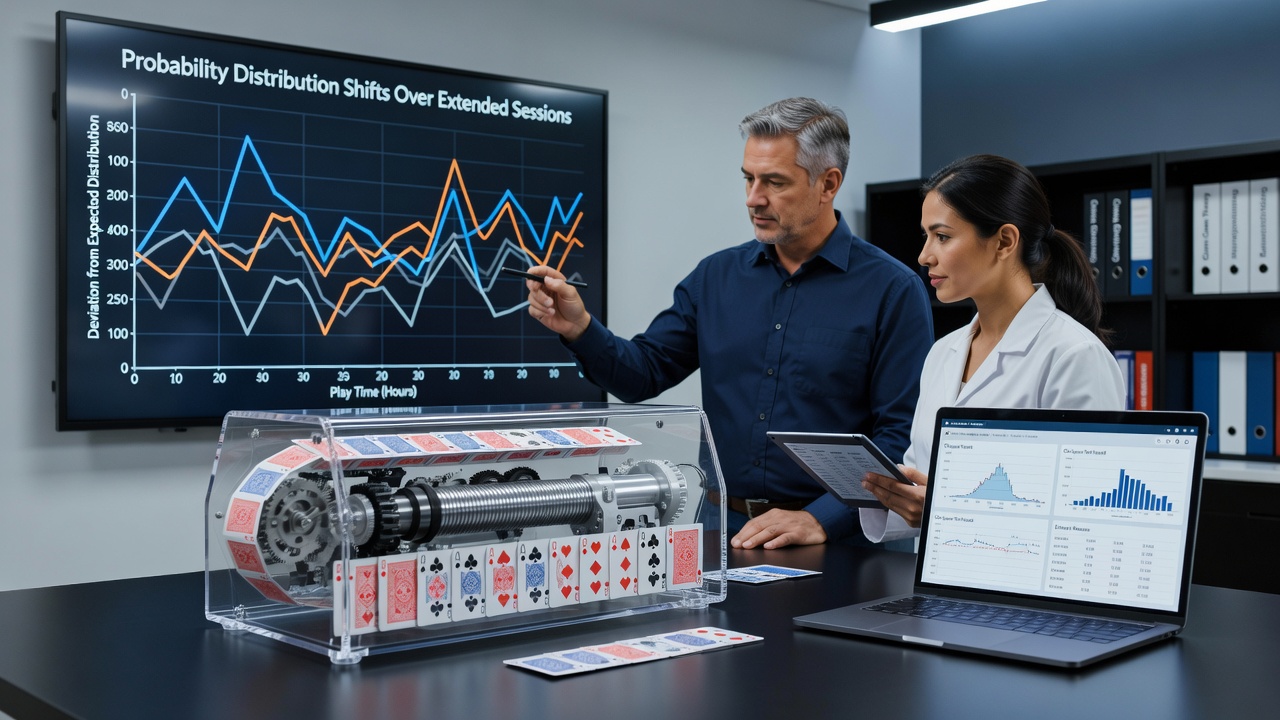
Studies from the University of Nevada, Reno, demonstrate that continuous shuffling stabilizes the distribution of key card values such as aces and tens over thousands of hands, because the machine resets the shoe composition frequently enough to eliminate cumulative depletion. Figures reveal that in a standard eight-deck shoe without continuous shuffling, the probability of drawing a ten-value card can shift by several percentage points after several hundred cards have been played, yet the same metric remains nearly constant when a continuous shuffle machine operates at standard speeds.
Those who track outcomes across regulated tables find that house edge calculations stay aligned with theoretical values more consistently under continuous shuffle conditions, and this consistency arises because the machine prevents extreme concentrations of high or low cards from persisting into later portions of a session. What's interesting is how this affects multi-hand play, since players who remain at the table for extended periods encounter probability structures that reset repeatedly rather than evolve toward the end of a shoe.
Regulatory Standards and Session-Length Data
Regulators in jurisdictions including those overseen by the Australian Communications and Media Authority require periodic testing of continuous shuffle machines to verify that output randomness meets established thresholds, and these tests focus on long-run distribution metrics rather than single-hand results. In July 2026, updated compliance frameworks from multiple North American gaming authorities emphasized expanded monitoring of session-length probability stability, requiring operators to log distribution samples at regular intervals during live play.
Industry reports compiled by the Canadian Gaming Association indicate that casinos using continuous shuffle technology record lower variance in win rates across extended player sessions compared to venues relying on periodic manual or automatic shuffles, because the machines maintain closer adherence to baseline probabilities. Researchers discovered through simulation models that sessions spanning four or more hours show probability drift reductions of up to 40 percent when continuous shuffling is active, although actual table results still depend on specific game rules and player decisions.
Comparison With Traditional Shoe-Based Play
Traditional multi-deck shoes allow running counts to gain predictive value as cards are depleted, and this creates measurable changes in conditional probabilities for remaining hands, whereas continuous shuffle machines interrupt that process by reintroducing cards before significant depletion occurs. Evidence suggests that the difference becomes most pronounced after the first 100 to 150 cards have been played in a session, at which point non-shuffled shoes begin to diverge from initial distributions while shuffled ones remain aligned.
Those who analyze regulatory filings note that approved continuous shuffle models must demonstrate equivalent or superior randomness performance to periodic shufflers over extended test periods, and this requirement ensures that probability distributions do not favor either the house or players beyond established mathematical expectations. The ball remains in the operators' court to maintain calibration logs that regulators can review during routine inspections.
Conclusion
Continuous shuffle machines therefore function as stabilizers of probability distributions in regulated blackjack environments, and their effect becomes increasingly relevant during extended play sessions where traditional shoes would otherwise allow cumulative changes to develop. Data from multiple oversight bodies confirms that these devices keep card value frequencies closer to theoretical baselines across thousands of hands, which in turn supports consistent application of game mathematics regardless of session duration. Regulatory updates scheduled through 2026 continue to refine testing protocols for these machines, ensuring that probability integrity remains a core compliance metric in jurisdictions worldwide.