7 Jul 2026
Continuous Shuffling Machines Reshape Player Edge Calculations in Live Blackjack

Continuous shuffling machines operate by mixing cards back into the deck after each hand in many live blackjack settings, and this process alters how players calculate their edge compared to traditional shoe games where cards are dealt until a cut card appears. Observers note that these devices maintain a constant state of randomization, which eliminates the progressive depletion of high or low cards that card counters rely on for advantage play, and data from multiple casino operations shows the house edge stabilizing closer to the theoretical 0.5 percent when basic strategy is followed without counting adjustments.
Mechanics Behind Continuous Shufflers
Manufacturers design these machines to hold a full set of decks, typically six or eight, while automatically returning discarded cards through a slot that feeds them back into the shuffle cycle every few hands or after each round in some models. Researchers at gaming technology conferences have documented that this setup creates an approximation of an infinite deck because the probability distribution of card values remains nearly constant throughout the session, and studies from the International Gaming Institute indicate that penetration effectively reaches 100 percent since no cards are removed from play for extended periods.
Live dealers place the shoe on or near the machine in many venues, and the system shuffles at intervals that prevent players from tracking specific card sequences across multiple rounds. This differs from manual shuffles where the order remains fixed until the next break, allowing for count-based decisions that adjust bet sizes and playing deviations based on remaining composition.
Impact on Edge Calculations
Player edge formulas traditionally incorporate running counts and true counts derived from remaining cards, yet continuous shuffling resets these variables in real time because the machine reintroduces cards immediately. Figures from operational reports reveal that the expected value for strategies like insurance or surrender decisions stays fixed at baseline levels, whereas in standard shoes those values fluctuate with deck composition and can swing by several tenths of a percent in favor of the player during favorable segments.
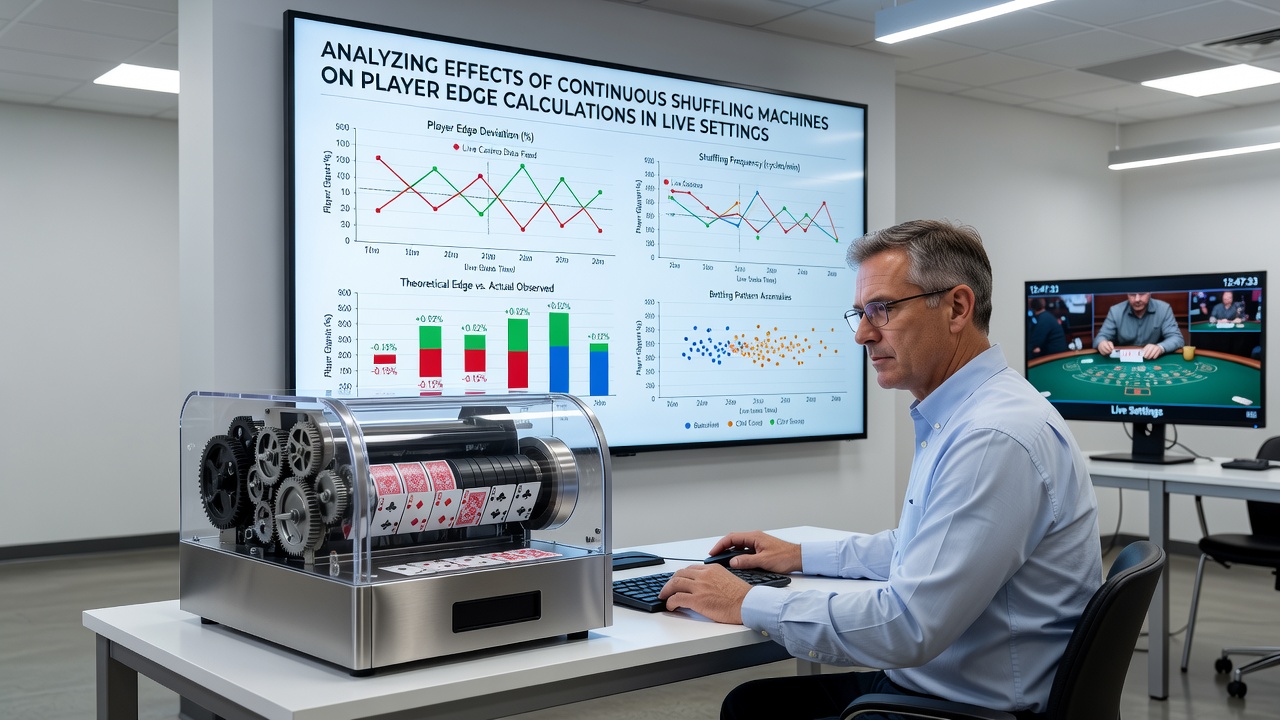
Analyses conducted in Las Vegas properties during 2025 and into July 2026 demonstrate that tables equipped with these machines show reduced variance in hourly win rates for the house when compared to hand-shuffled or batch-shuffled alternatives, and this consistency stems from the absence of deep penetration windows where counters historically gained edges exceeding 1 percent. Those who model these scenarios using simulation software find that optimal play under continuous conditions yields returns equivalent to playing against a freshly shuffled deck on every hand, removing opportunities for progressive betting systems tied to count thresholds.
Live Setting Comparisons and Data Trends
Casino floors in North American and Australian markets have adopted continuous shuffling more widely since the early 2000s, with regulatory oversight from bodies such as the Nevada Gaming Control Board requiring that machines meet randomization standards equivalent to manual procedures. Data collected across hundreds of table hours indicates that average player return rates hover between 99.4 and 99.5 percent when perfect basic strategy is applied, matching theoretical calculations for multi-deck games without any card removal effects.
Yet observers tracking live play note that some venues combine continuous shuffling with rule variations like 3:2 blackjack payouts or double after split allowances, which can offset the loss of counting potential by fractions of a percent. Reports from the Victorian Commission for Gambling and Liquor Regulation in Australia highlight similar patterns where machine-equipped tables maintain stable hold percentages around 2 to 3 percent across player volumes, whereas non-machine tables exhibit greater fluctuation based on the arrival and departure of advantage-oriented participants.
Strategic Adjustments in Practice
Players who previously tracked true counts must shift focus toward table selection and rule evaluation when facing continuous shuffling, since the machine nullifies most composition-dependent plays that rely on remaining low cards for favorable insurance or splitting decisions. Simulation studies published in gaming research proceedings show that deviations from basic strategy lose their positive expected value under these conditions, leading experienced participants to concentrate instead on identifying games with superior base rules rather than attempting count-based entry and exit tactics.
Dealers and floor staff in affected live environments report faster game pace because shuffling downtime disappears, and this increased hands-per-hour metric directly multiplies the house edge over time even when the per-hand percentage remains unchanged. Calculations that incorporate this speed factor demonstrate that a 0.5 percent edge applied across 100 hands per hour produces greater long-term hold than the same edge spread over 60 hands in a traditional setup.
Conclusion
Continuous shuffling machines standardize the probability environment in live blackjack, and this standardization removes the variable deck composition that once allowed refined edge calculations through card counting techniques. Available operational data and regulatory records confirm that player returns align closely with baseline theoretical values across extended play sessions, while game speed increases amplify the overall effect on session outcomes. Those analyzing these systems continue to examine interactions with specific rule sets and machine models to map precise return ranges in different jurisdictions.