11 Jul 2026
Digital Shuffling Mechanisms and Their Effects on Blackjack Probability Patterns Across Prolonged Sessions
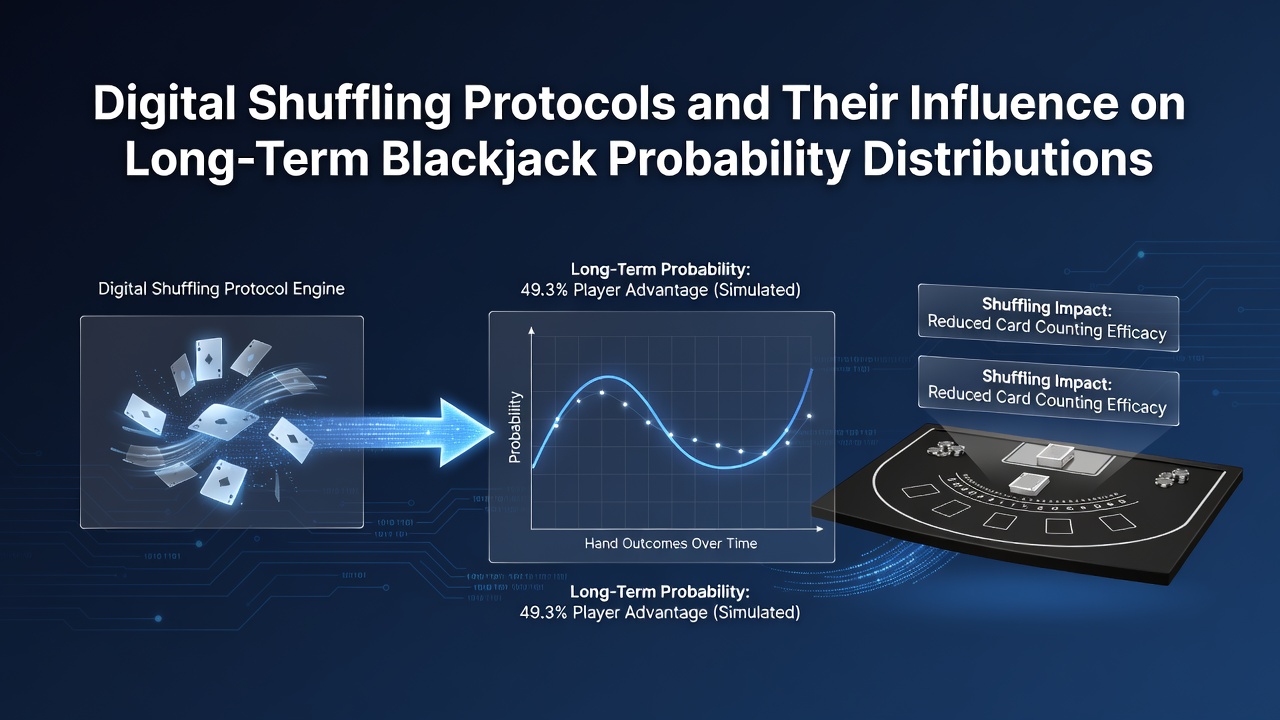 Digital shuffling protocols rely on algorithmic processes that reorder virtual card decks in online and electronic blackjack environments, and these systems generate sequences through pseudo-random number generators that meet certification standards set by gaming laboratories. Observers note that such protocols replace the physical cut and riffle actions seen in land-based tables, yet they aim to produce uniform distributions equivalent to those from manual methods when properly implemented. Research from regulatory bodies indicates that approved generators undergo extensive statistical testing before deployment, which ensures each card position holds equal probability across millions of simulated deals. The core function involves seeding an algorithm with an initial value drawn from hardware entropy sources, after which the generator produces a stream of numbers mapped to card positions in the deck array. Gaming authorities in Nevada require that these sequences pass tests for independence and uniformity, and similar requirements appear in reports from the New Jersey Division of Gaming Enforcement. Data from laboratory evaluations shows that certified systems exhibit no detectable bias within practical session lengths, although the deterministic nature of pseudo-random generators means the entire sequence repeats after a very long period.
Algorithmic Foundations and Deck Reordering
Modern implementations commonly employ variants of the Mersenne Twister or Fortuna algorithms because these exhibit long periods and strong statistical properties according to published analyses by computer science researchers. Each shuffle operation draws enough random values to permute the 52-card array without repetition, and the process repeats after every round in continuous-shuffle modes or at set intervals in batch-shuffle modes. Studies conducted at academic institutions reveal that the resulting permutation distributions converge to the theoretical uniform measure as the number of trials increases, which aligns with the law of large numbers applied to card ordering.
Operators configure parameters such as shuffle frequency and reseed intervals to balance computational load against randomness quality, and these choices directly influence how quickly the system cycles through possible deck states. Figures from industry compliance audits indicate that most platforms reseed at least once per hour, which resets the generator state and prevents any player from observing enough outcomes to map the sequence. Yet the underlying mathematics remains unchanged: every valid permutation retains identical probability under a correctly functioning protocol.
Long-Term Probability Distributions in Practice
Over extended play periods the cumulative effect of repeated digital shuffles produces outcome frequencies that match the combinatorial expectations of a freshly randomized 52-card deck. Analysts who examined millions of hands from regulated platforms found that the observed distribution of player totals, dealer upcards, and final results stayed within confidence intervals predicted by standard probability models. This convergence occurs because each shuffle draws from the full permutation space without memory of prior states, provided the generator passes its certification battery.
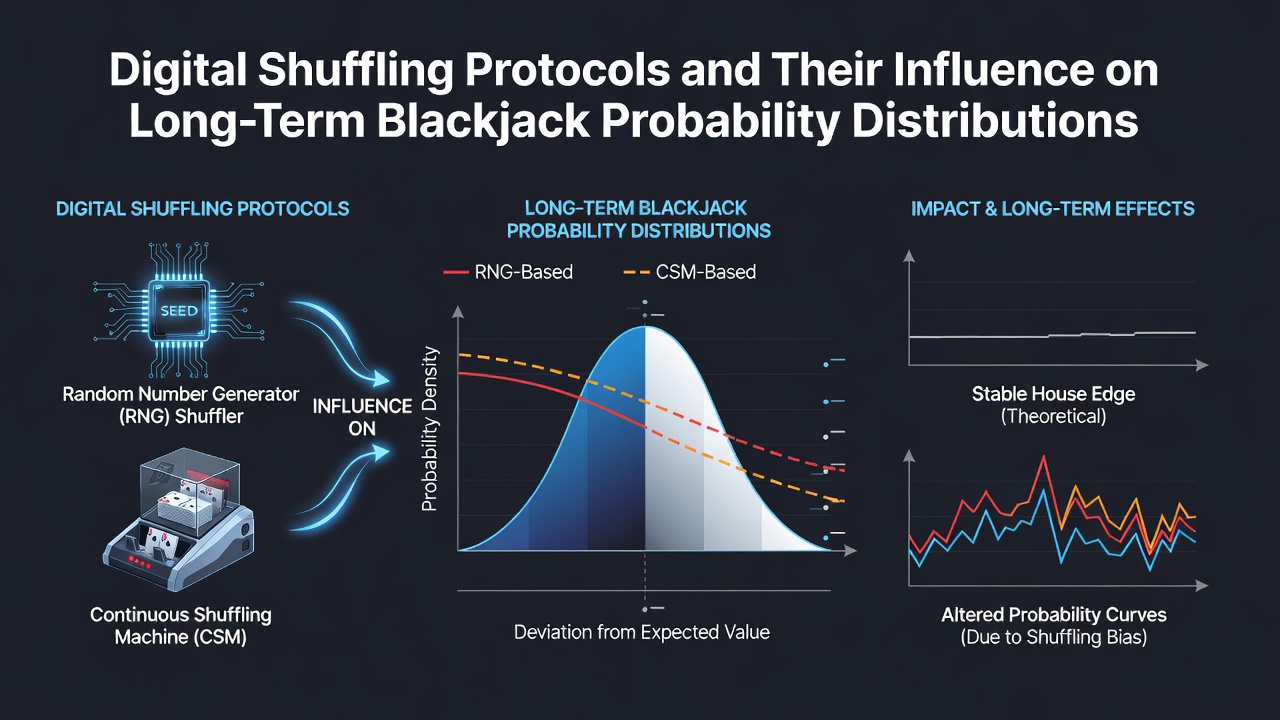
Continuous shuffling protocols, which reorder the remaining cards after each hand, alter short-term dependencies compared with traditional cut-card mechanics, yet long-term distributions remain identical once the sample size grows large. Reports issued by the Australian Communications and Media Authority document that electronic tables using continuous digital shuffles exhibit the same house-edge percentages as their physical counterparts when measured across hundreds of thousands of rounds. The key distinction lies in the elimination of human shuffle imperfections such as clumping or incomplete mixing, which some physical studies have shown can create transient biases that dissipate over time.
Regulatory Standards and Testing Protocols
Certification bodies require generators to pass suites including the DIEHARD and NIST statistical test batteries, and they mandate periodic re-evaluation when software updates occur. European regulators in Malta impose additional entropy-source requirements that differ from North American approaches, creating a patchwork of compliance frameworks that operators must navigate. Data collected by these agencies shows that failures remain rare after initial approval, which supports the claim that deployed systems maintain distributional integrity throughout their operational lifespan.
Players encounter no practical deviation from theoretical probabilities when they participate at sites that publish their certification details, and independent test houses continue to monitor live deployments through sampling programs. The reality is that any influence on long-term distributions stems from implementation errors rather than inherent limitations of the algorithmic approach itself.
Conclusion
Digital shuffling protocols, once certified and correctly maintained, preserve the same long-term probability distributions that govern physical blackjack because each permutation receives equal weighting under uniform random selection. Regulatory testing and statistical validation provide the evidence that supports this equivalence, and ongoing oversight by multiple international bodies ensures continued adherence to those standards. As platforms evolve their algorithms and reseeding practices, the fundamental mathematical relationship between shuffle method and outcome distribution stays constant for all practical purposes.