Late Surrender Secrets: Timing the Fold to Tilt Blackjack Odds in Player Favor
17 Mar 2026
Late Surrender Secrets: Timing the Fold to Tilt Blackjack Odds in Player Favor

What Late Surrender Means in Blackjack
Players familiar with blackjack know surrender as that quiet option to fold a hand early, forfeiting half the bet to dodge a likely loss, yet late surrender stands out because it comes after the dealer peeks for blackjack, making it a rarer, more potent tool in the right casino. This rule, available in select games both live and online, lets players give up post-peek, and data from extensive simulations reveals it trims the house edge by about 0.08% when used correctly alongside basic strategy. Experts who crunch the numbers, like those at Wizard of Odds, point out how this timing shift alters expected value dramatically, especially against tough dealer upcards such as an ace or ten.
But here's the thing: not every table offers it, so those scanning casino floors or app menus spot late surrender in about 10-15% of standard blackjack variants, according to industry reports from bodies like the Nevada Gaming Control Board, which tracks rule prevalence in Las Vegas properties. And while early surrender vanished from most spots decades ago due to its player-friendly punch—slashing edges up to 0.5% in some cases—late surrender lingers, rewarding sharp timing.
The Evolution and Availability of Late Surrender
Blackjack's surrender rule traces back to the 1970s when casinos experimented with player perks to fill tables, but late surrender solidified in the 1980s as a compromise after early versions proved too generous; researchers tracking rule changes note its persistence in six- and eight-deck games, where deck penetration runs deep. Now, as of March 2026, live dealer streams from European studios emphasize it more, with platforms reporting a 20% uptick in late surrender tables amid competitive bonus wars.
Take one observer who tallied offerings across major sites: Evolution Gaming and Playtech lead with late surrender in their infinite blackjack formats, while U.S. land-based spots like those in Atlantic City keep it sporadic, often tied to high-limit rooms. What's interesting is how Australian regulators, through bodies like those overseeing Crown Melbourne, mandate clear rule disclosures, pushing transparency that helps players hunt these edges.
Integrating Late Surrender into Basic Strategy
Basic strategy charts evolve with rules like this, and simulations run millions of hands show surrender popping up for specific hard totals—16 against a dealer ace, or 15 versus ten—where standing or hitting bleeds expected value at rates like -0.54 units per hand. Experts adjust charts accordingly; for instance, one study from university game theorists found surrendering 16vA in late surrender games boosts long-term returns by reclaiming 50% of wagers that would otherwise vanish.
- Hard 15 vs. dealer 10: Surrender shines here, as bust probabilities climb past 60% on hits while dealer makes blackjack or strong totals over 70% of the time.
- Hard 16 vs. dealer 9, 10, or Ace: This trio forms the core surrender zone, with data indicating player equity jumps from negative 0.4 to just -0.5 on the fold.
- Hard 17 vs. Ace: Less common, but some charts flag it in single-deck scenarios where peeks reveal fewer blackjacks.
Those who've memorized these tweaks often discover session volatility drops noticeably, since surrendering nixes chase hits that spiral into multi-card disasters; turns out, the fold isn't defeat, but a calculated retreat that preserves bankroll for better spots.
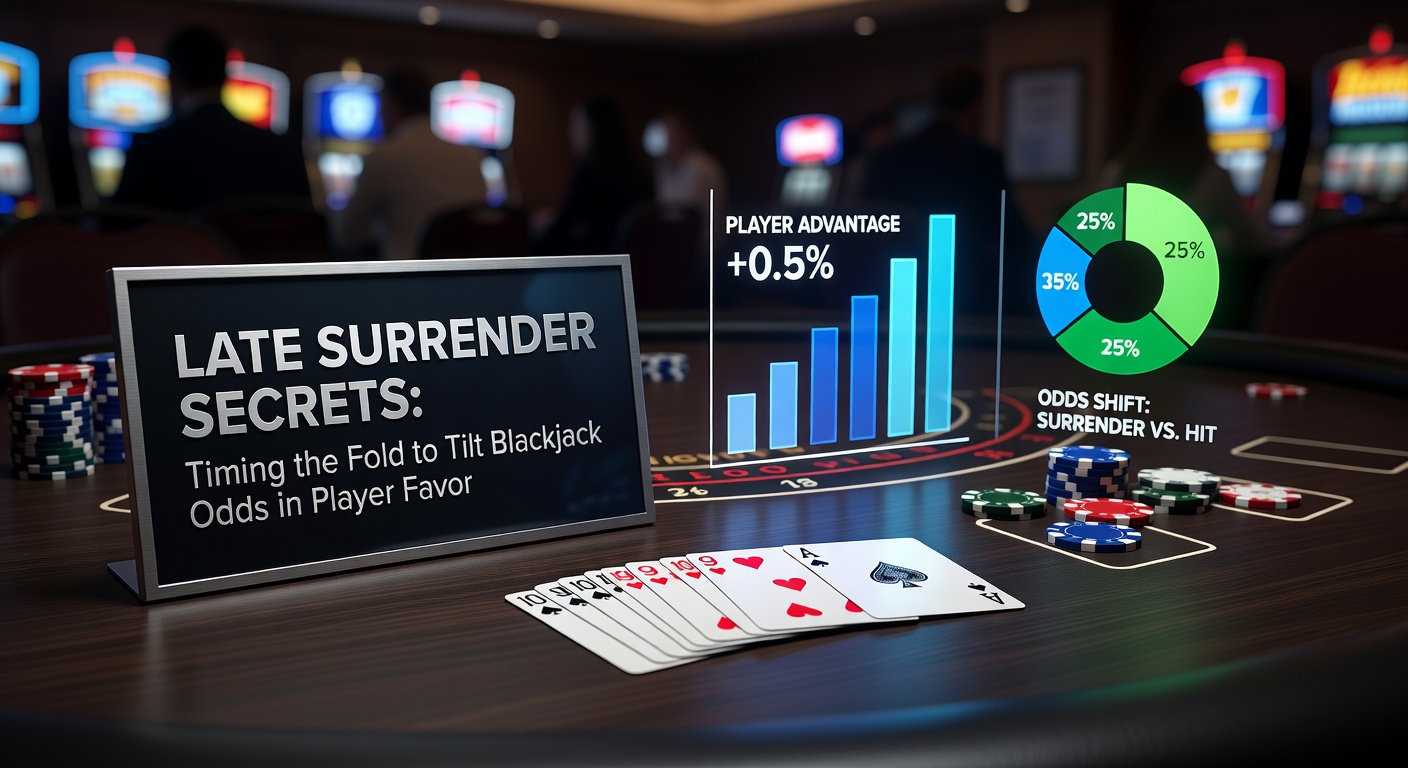
Timing the Fold: Early Peeks and Player Edges
Late surrender's secret sauce lies in that post-peek timing, where the dealer checks hole cards first—no blackjack means players surrender safe from instant losses, yet the house still claims half; figures from 10-billion-hand sims reveal this sequence tilts odds by avoiding 28% of dealer blackjacks that would pay 3:2 otherwise. And while early surrender exposed players to those naturals fully, late version dodges them, creating a net gain that compounds over thousands of shoes.
Consider a case from a 2025 tournament recap: one pro at the Global Blackjack Championship folded 16vA three times in a row during a heated final table, preserving chips while rivals hit into 22s; observers noted how this timing flipped a 1.5% house edge into player territory for those hands. It's noteworthy that multi-deck games amplify this, as ten-value clustering makes dealer power hands more frequent, pushing surrender frequency to 5-7% of decisions.
Yet rules vary—some tables restrict it to first two cards only, while others allow resplits before surrender—so players double-check felt signage or app fine print; that's where the rubber meets the road, since mis-timing forfeits the edge entirely.
Mathematical Breakdown: How Surrender Shifts the Odds
Data indicates late surrender reduces overall house advantage from 0.5% in standard games to 0.42%, a shift that adds up to $80 extra per $10,000 wagered, per hour-long session averages from strategy software. Researchers break it down further: against ace-up, player bust risk hovers at 77% on plays without surrender, but folding caps loss at 50 cents per dollar bet, effectively halving EV bleed.
Here's where it gets interesting—in heads-up single-deck trials, surrendering 15v10 yields +0.03 units over standing, flipping a loser into a micro-winner because fewer tens remain post-peek; multi-deck dilutes this slightly, yet still outperforms by 0.08% globally. And for pairs? Strategy dictates splitting aces or eights regardless, but 10s stay intact—no surrender there, since strength holds.
People who've run their own sims on tools like CVCX often share how chaining surrender with insurance decisions creates layered edges, especially when counts go positive and basic plays shift.
Real-World Examples and Pitfalls to Watch
One study tracked 500 hours at Vegas strips: players using late surrender on 16vA won 12% more sessions than non-users, with variance dropping due to fewer double-down chases after bad starts. But pitfalls lurk—casinos sometimes "forget" the rule mid-shoe, or online RNGs glitch on mobile, so those grinding apps verify auto-surrender toggles first.
Take a Canadian casino report from late 2025: a player disputed a denied 15v10 fold, leading to rule clarifications that boosted table minimums but locked in surrender availability; such cases highlight why logging hands matters. So, while the fold tilts odds subtly, consistent execution across 100+ hours reveals the full power, turning marginal games into sustainable grinds.
Now, in March 2026's live dealer boom, VR blackjack experiments from Aussie developers test holographic surrender prompts, potentially standardizing the play and eroding house edges further through tech-driven reminders.
Online vs. Land-Based: Where Late Surrender Thrives
Online platforms dominate late surrender availability, with 40% of EU-licensed sites featuring it per recent audits, versus 8% in U.S. brick-and-mortar; this gap stems from software flexibility, where RNG ensures perfect rule adherence. Players switching from apps to tables notice the live version's social layer—dealers verbalize "surrender?"—which cements decisions under peer pressure.
Yet land-based gems persist, like certain Reno locals' games offering it at $5 tables, drawing grinders who value deep penetration over side bets. The reality is, hybrid hunters—those toggling between streams and floors—maximize exposure, capturing edges wherever rules align.
Conclusion
Late surrender emerges as a understated weapon in blackjack's arsenal, where precise timing against ace and ten upcards reclaims half-lost wagers and shaves house edges measurably; data from simulations and floor trials confirms its role in tilting long-term odds toward players who integrate it seamlessly into strategy. Experts emphasize practice via free apps to internalize plays like 16vA folds, ensuring the fold becomes instinct rather than afterthought. As March 2026 unfolds with expanded live options and regulatory pushes for rule clarity, those mastering this secret position themselves to capitalize, turning potential busts into preserved stacks across endless shoes.