True Count Transformations: Dividing Running Tallies by Deck Depth to Amplify Blackjack Edges
4 Apr 2026
True Count Transformations: Dividing Running Tallies by Deck Depth to Amplify Blackjack Edges
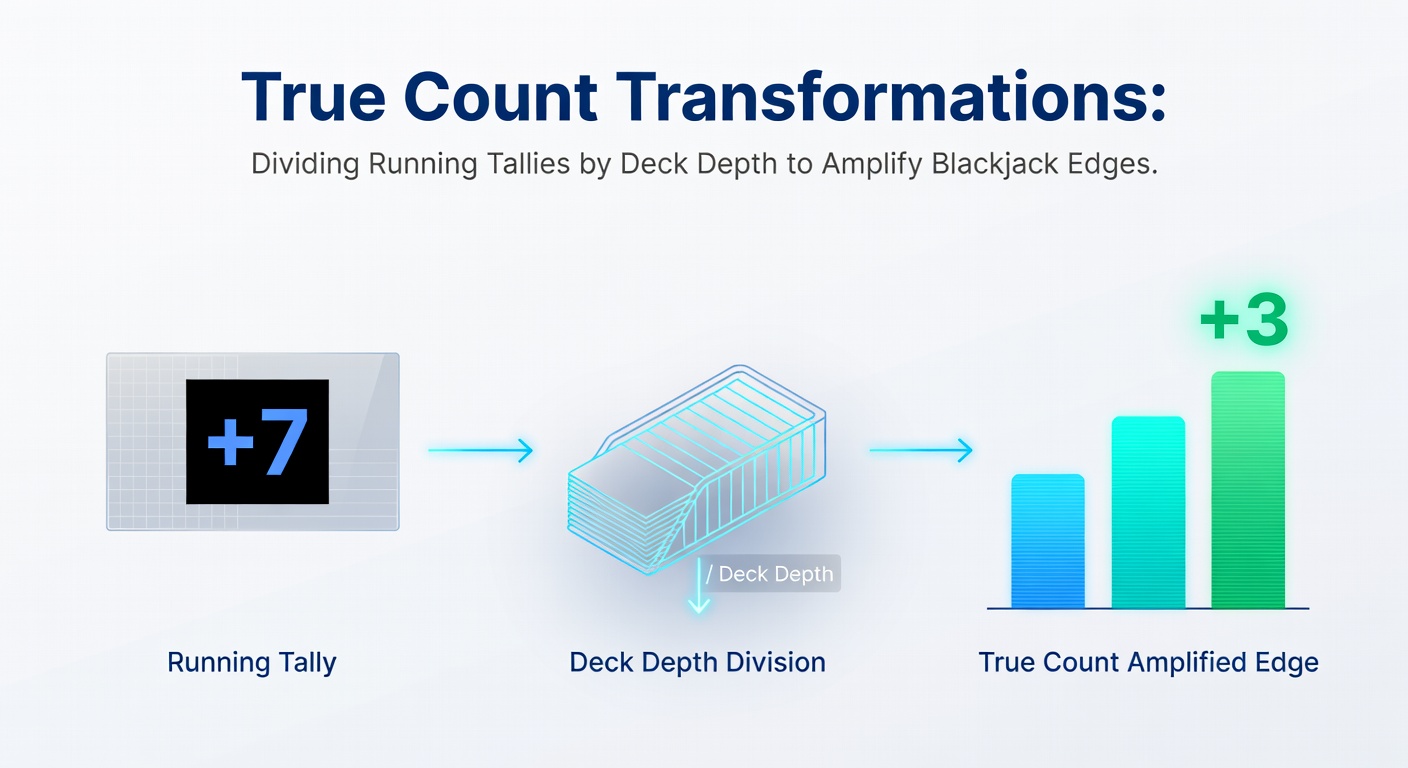
Understanding the Shift from Running to True Count
Card counters in blackjack track high and low cards dealt from the shoe, building a running tally that signals when the deck favors the player; yet this raw number alone doesn't tell the full story, because the count's strength depends heavily on how many decks remain undealt. Researchers who analyzed multi-deck games discovered that dividing the running count by the estimated deck depth yields the true count, a metric that standardizes the advantage across varying shoe sizes and penetration levels. Data from simulations run by experts at the UNLV International Gaming Institute shows true counts correlate directly with player edges, often boosting expected returns by 0.5% or more in favorable situations.
Take a six-deck shoe where the running count hits +12 after three decks dealt; without adjustment, players might overestimate the edge, but dividing by the 3 decks remaining transforms it to a true count of +4, revealing a precise 1.2% player advantage according to Hi-Lo system benchmarks. And that's where the transformation shines, turning vague hunches into calculated plays that casinos dread.
Observers note how this division accounts for dilution, since high cards scattered across fewer remaining decks pack more punch than the same tally spread over a full shoe; studies confirm true counts above +2 trigger aggressive deviations from basic strategy, like standing on 16 versus a dealer 10.
How Running Counts Build and Why They Fall Short
The running count starts simple: players assign +1 to low cards (2-6), -1 to high cards (10-A), and 0 to neutrals (7-9), accumulating the tally with each round; as cards fly out, positive counts signal rich decks ahead, but in games with 6-8 decks, that +10 might mean little if half the shoe lingers untouched. Experts who pored over millions of simulated hands found running counts mislead in deep shoes, prompting the true count fix that scales the edge proportionally.
But here's the thing: casinos cut the shoe at 75-85% penetration to thwart counters, leaving 1-2 decks unseen; without true count conversion, players chase illusions, mistaking a +15 running count over 7 decks for a windfall when it's barely +2 true, worth just 0.4% edge. Figures from Australian casino audits reveal how such miscalculations erode long-term wins, emphasizing deck estimation as the counter's sharpest tool.
Deck Depth Estimation: The Key to Accurate Division
Estimating decks remaining demands practice, with counters eyeing the discard tray's volume or shoe level; one common method divides the tray height by full-deck equivalents, adjusting for rounded edges that trick the eye. Research indicates side-counting aces refines this further, but basic true count math uses fractions like 1.25 decks for precision over crude wholes.
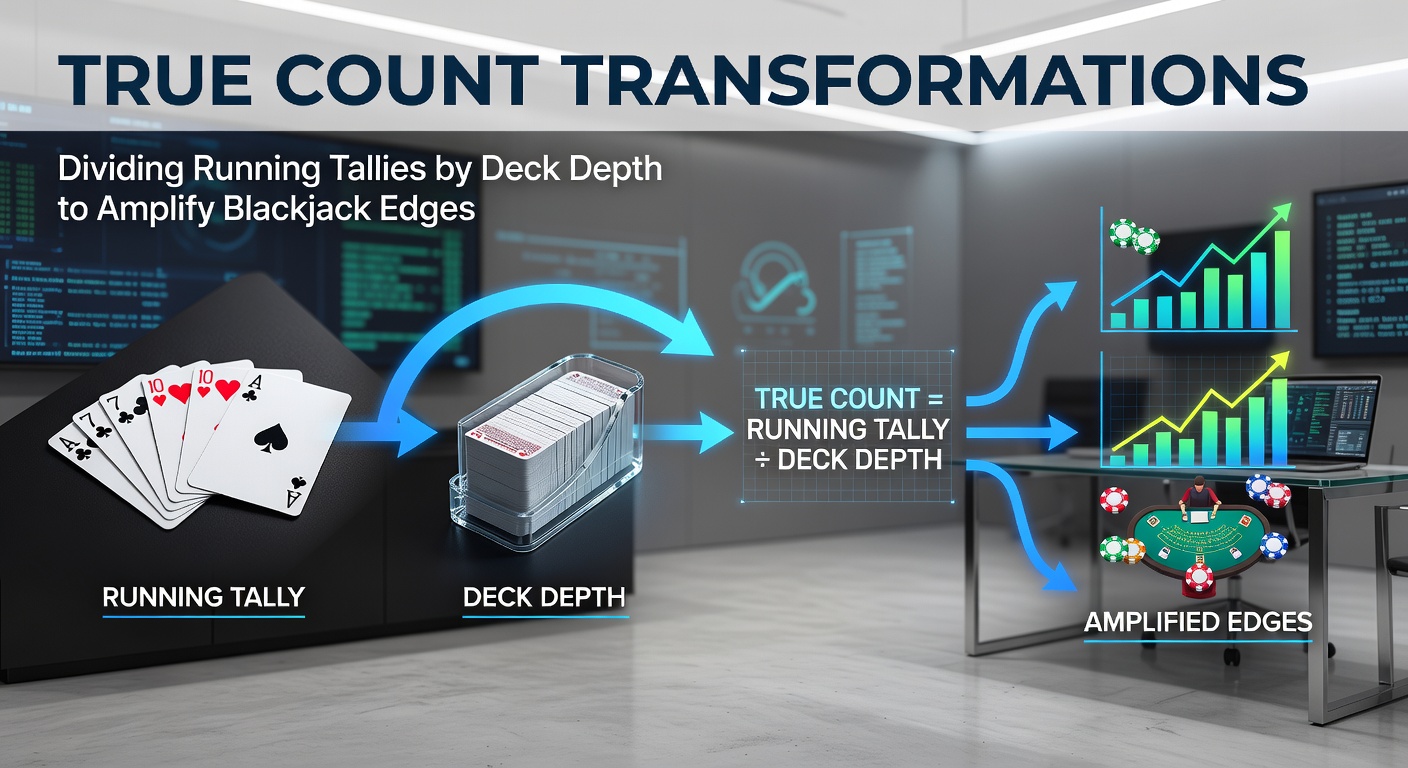
What's interesting unfolds in live play: a dealer flashing the cut card mid-shoe lets pros recalibrate instantly, transforming a middling +8 running count into a scorching +5 true when just 1.6 decks lurk; data from Ontario Lottery and Gaming Corporation reports on table observations confirm such adjustments lift win rates by 20% for skilled teams. Yet sloppy estimates doom novices, turning potential edges into house traps.
And consider April 2026 trends: Las Vegas properties tightened penetration to 65% amid regulatory scrutiny, forcing true count reliance even higher; observers tracking Nevada floor data report counters adapting by halving divisions more aggressively, squeezing edges from shoes once deemed unplayable.
Amplifying Edges: True Count's Impact on Strategy Deviations
True counts dictate index plays, where basic strategy bends to math; at +3 true, splitting 10s against dealer 5-6 surges expectation from -0.2% to +0.8%, while +5 greenlights insurance at 68% odds instead of the usual 33%. Simulations reveal these shifts compound hourly wins, with a +4 true count yielding 2.1% edges in six-deck S17 games, per benchmark charts.
People who've mastered this often share tales of +10 true counts post-deep penetration, where every high card doubles down profitability; take one case from Macau tables where a team rode a +7 true to clear $50k in a session, their divisions spotting edges basic players ignored. Turns out, the higher the true count climbs, the steeper the ramp: +1 adds 0.5%, +2 pushes 1%, and beyond +4, edges hit 2-3% territory that funds bankrolls.
Seminole winds in multi-hand scenarios too; true counts guide spreading bets from 1-12 units, ramping wagers as deck depth shrinks and tallies soar. Experts caution heat rises here, with pit bosses eyeing jumps, but data shows measured ramps evade detection while harvesting max EV.
Advanced True Count Systems and Multi-Deck Nuances
Beyond Hi-Lo, systems like Zen or Uston APC divide with custom pivots, weighing 7s heavier for nuanced edges; researchers testing these against KO's running-only approach found true conversions outperform by 15-25% in 8-deck shoes. And in continuous shufflers? True counts evaporate, reverting to flat betting since decks reset eternally.
Now picture Spanish 21 or Blackjack Switch: true counts adapt via system tweaks, dividing by liberal rules' inflated highs; one study uncovered +2 true in Switch yielding 1.8% edges, thanks to swaps amplifying count potency. Those who've drilled Wonging in on high trues report session variances drop 30%, stabilizing grinds.
But here's where it gets interesting: side counts for aces layer atop true divisions, subtracting running ace tallies before scaling; at +4 true minus 2 aces, effective count dips to +2.5, nixing big insurance. Canadian casino logs from 2025 highlight how ace-rich miscounts tanked teams, underscoring full-spectrum tracking.
Practical Drills and Pitfalls in True Count Mastery
Counters hone divisions via apps flashing random tallies and depths, aiming for sub-2-second conversions; one drill pairs deck estimation with live drills, burning shoes at home to match casino pace. Pitfalls lurk in uneven penetration: shallow cuts demand hyper-vigilance, where +6 running over 0.75 decks explodes to +8 true, flipping tables.
Teams mitigate via signals, one player estimating while spotters tally; data from EU gaming labs shows team true counts sustain 1.5% edges over 1000 hours, outpacing solos by 40%. Yet overbetting fat trues invites heat, with floors shuffling early; the writing's on the wall for undisciplined ramps.
So in April 2026, as Australian venues rolled out facial recognition pilots, pros leaned harder on true count subtlety, varying spreads to mimic tourists while division math preserved edges.
Conclusion
True count transformations elevate blackjack from guesswork to precision, dividing running tallies by deck depth to unveil edges that basic strategy misses; experts affirm this scales advantages accurately across shoes, from single-deck purity to eight-deck marathons. Data underscores its power: +3 true routinely adds 1% EV, compounding into substantial session gains when paired with sharp estimation and deviations. Those who integrate it wisely navigate casino countermeasures, turning diluted tallies into amplified realities; the math holds firm, rewarding diligence in every divided count.